

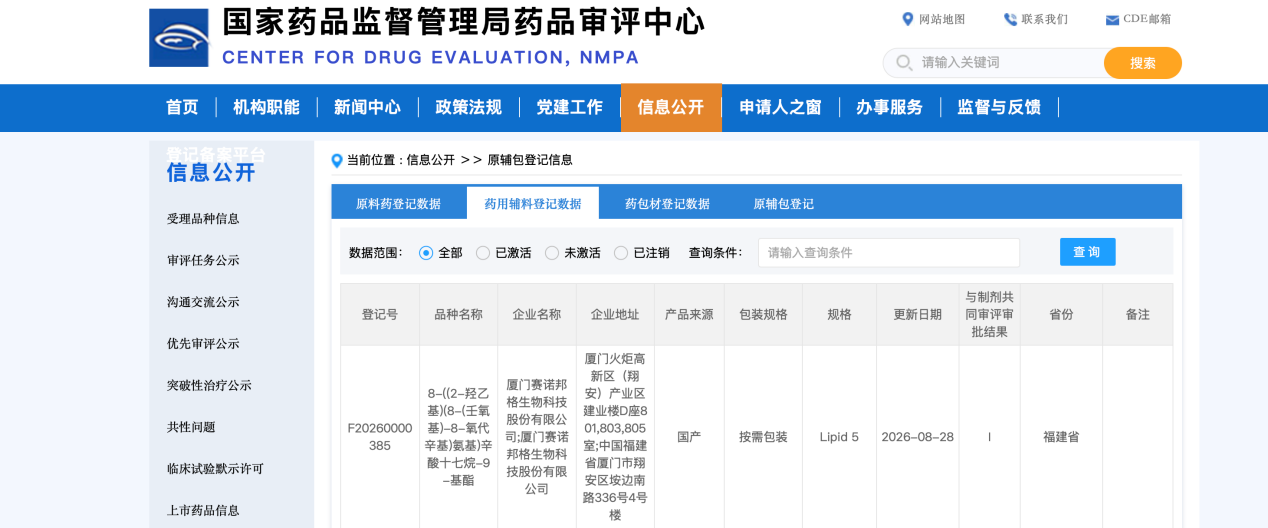
Source: Center for Drug Evaluation, National Medical Products Administration (NMPA)
Recently, Sinopeg has achieved another significant milestone in the field of LNP lipid excipients — the ionizable lipid Lipid 5 has completed its pharmaceutical excipient registration filing with the Center for Drug Evaluation (CDE) of the National Medical Products Administration (NMPA), with CDE Registration Number: F20260000385.
This milestone marks another strategic addition to Sinopeg's portfolio of lipid excipient products for nucleic acid drug delivery, providing downstream companies engaged in LNP-based nucleic acid drug development with an excipient option supported by regulatory filing documentation.
01 About Lipid 5
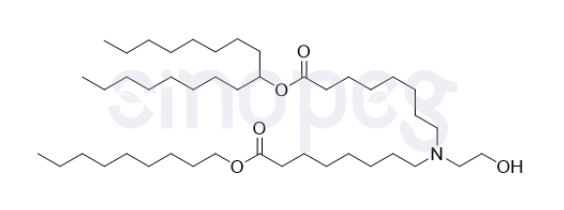
Product Name:
17-yl heptadecan-9-yl 8-((2-hydroxyethyl)(8-(nonyloxy)-8-oxooctyl)amino)octanoate
Short Name: Lipid 5※
Molecular Formula: C₄₄H₈₇NO₅
Lipid 5 is an ionizable lipid(ionizable cationic lipid) that serves as a key functional excipient in LNP (lipid nanoparticle) delivery systems. It plays a critical role in the loading of nucleic acid drugs, intracellular delivery, and endosomal escape.
Mechanism at a glance: Under physiological pH conditions, LNPs containing Lipid 5 remain largely electroneutral, effectively reducing non-specific adsorption. Upon cellular uptake and exposure to the acidic endosomal environment, Lipid 5 becomes protonated and interacts with the negatively charged endosomal membrane lipids, promoting endosomal membrane perturbation and endosomal escape, thereby facilitating the sufficient release of nucleic acids into the cytoplasm.
Three Key Application Values
Well-established in vitro and in vivo research foundation
Lipid 5 has been successfully applied in both in vitro and in vivo mRNA delivery studies, with demonstrated protein expression in rodent and non-human primate models, providing a research basis for its future applications in nucleic acid drug delivery.
Key component for nucleic acid drug delivery
As an important component of LNP formulations, ionizable lipids are widely used in delivery systems for mRNA and other RNA-based drugs, making them essential lipid excipients in the development of nucleic acid pharmaceutical formulations.
pH-responsive charge modulation and functional advantages
Compared to conventional permanently cationic lipids, ionizable lipids can dynamically adjust their charge state in response to changes in environmental pH. They play distinct roles at various stages, including nucleic acid complexation, LNP formation, and intracellular release, balancing both delivery efficiency and biocompatibility.
02 Why is CDE Filing So Important?
In accordance with the NMPA's requirements for the joint review and approval of active pharmaceutical ingredients, excipients, and packaging materials, pharmaceutical excipients can be registered through the CDE's platform for such materials and undergo joint review and approval during the drug product registration application process.
Regulatory Cornerstone
The completion of pharmaceutical excipient registration filing for Lipid 5 signifies that it has obtained legal status as a pharmaceutical excipient, enabling it to provide full compliance documentation support for subsequent formulation-related joint reviews, thereby further strengthening the foundation for product development and regulatory submission.
Customer Enablement
For clients engaged in the development of nucleic acid drugs such as mRNA and siRNA, pharmaceutical excipients that have already undergone registration filing can support formulation development and subsequent regulatory submissions, improving the efficiency between excipient supply and formulation filing efforts.
03 Multi-Product Synergy, Building a One-Stop LNP Excipient Platform
The addition of Lipid 5 further enriches Sinopeg's diversified portfolio in ionizable lipids, cationic lipids, PEG lipids, and other related areas, offering a broader selection of excipients and compliance support for LNP formulation development. Sinopeg currently possesses an extensive matrix of CDE-filed and FDA DMF-listed products in the LNP lipid excipient space:
|
Product Short Name |
DMF (CDER) |
CDE |
|
mPEG-DMG-2K |
DMF 038025 |
F20210000399 |
|
mPEG-DTA-2K (ALC-0159)※ |
DMF 038112 |
F20210000384 |
|
DHA (ALC-0315)※ |
DMF 038107 |
F20220000045 |
|
HUO (SM-102)※ |
DMF 038143 |
F20210000505 |
|
Cholesterol |
DMF 038440 |
F20220000434 |
|
DOPE |
DMF 038416 |
F20210000586 |
|
mPEG-DTA-1-2K |
DMF 039451 |
F20230000444 |
|
DHA-1 |
DMF 039452 |
F20230000445 |
|
DSPC |
DMF 039769 |
F20230000605 |
|
DOTAP-Cl |
DMF 040073 |
F20240000161 |
|
DSPE-PEG-MAL(NH₄⁺)-2K |
- |
F20260000073 |
|
Lipid 5※ (this filing) |
- |
F20260000385 |
04 Why Choose Sinopeg?
As a professional supplier in the field of drug delivery systems, Sinopeg continues to advance the research, development, production, and regulatory compliance of drug delivery carriers and related excipients.
Extensive Compliance Experience
To date, the company holds 17 CDE-filed products and 22 Drug Master Files (DMFs) meeting FDA requirements.
Stringent Quality Management Systems
The company is certified under ISO 9001, ISO 13485, ISO 14001, ISO 45001, ISO 56005, and ISO 27001. Its laboratories and production workshops are designed and operated in strict accordance with FDA cGMP standards.
Continuous R&D Innovation
With over 50 invention patents, Sinopeg continues to deepen its expertise in LNP delivery, liposomes, long-acting formulations, and other areas, consistently launching novel excipients and solutions.
Note: This product is for pharmaceutical excipient use only, for drug research or production. For the CDE filing status, please refer to the official information published on the NMPA Center for Drug Evaluation website.
※: This product is protected by third-party patents. Our company does not supply this product, but only: (a) provides general technical consultation that does not conflict with patents; (b) accepts custom synthesis and CMO services under the condition of obtaining a license from the relevant third-party patent holder. Please contact us if needed.
1. Hou, X., Zaks, T., Langer, R. et al. Lipid nanoparticles for mRNA delivery. Nat Rev Mater 6, 1078–1094 (2021). https://doi.org/10.1038/s41578-021-00358-0
2. Sabnis S, Kumarasinghe ES, Salerno T, Mihai C, Ketova T, Senn JJ, Lynn A, Bulychev A, McFadyen I, Chan J, Almarsson Ö, Stanton MG, Benenato KE. A Novel Amino Lipid Series for mRNA Delivery: Improved Endosomal Escape and Sustained Pharmacology and Safety in Non-human Primates. Mol Ther. 2018 Jun 6;26(6):1509-1519. doi: 10.1016/j.ymthe.2018.03.010. Epub 2018 Mar 14. PMID: 29653760; PMCID: PMC5986714.
3. Han, X., Zhang, H., Butowska, K. et al. An ionizable lipid toolbox for RNA delivery. Nat Commun 12, 7233 (2021). https://doi.org/10.1038/s41467-021-27493-0
4. Chaudhary, N., Weissman, D. & Whitehead, K.A. mRNA vaccines for infectious diseases: principles, delivery and clinical translation. Nat Rev Drug Discov 20, 817–838 (2021). https://doi.org/10.1038/s41573-021-00283-5
5. 国家市场监督管理总局令(第27号)药品注册管理办法__2020年第14号国务院公报_中国政府网