

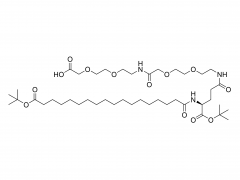
I. Product Overview
N-Fluorenylmethoxycarbonyl-Polyethylene glycol-Propionic Acid is a class of structurally precise, well-defined cleavable PEG linker reagents. Featuring an Fmoc protecting group and a terminal carboxylic acid connected via polyethylene glycol chains of various lengths, this series provides versatile molecular tools for bioconjugation, drug development, and chemical biology research.
II. Structural Features
Fmoc-protected amine: Removable under mild basic conditions (typically 20% piperidine/DMF) to expose a reactive amino group for subsequent conjugation.
Terminal carboxylic acid: Can be activated (e.g., with EDC or DCC) to form stable amide bonds with amino-containing compounds.
Tunable PEG chain length: Affects hydrophilicity, steric hindrance, and spacer distance.
Excellent physicochemical properties:
Enhanced water solubility and biocompatibility
Reduced immunogenicity and minimized non-specific interactions
Improved stability and half-life of drug molecules
III. Key Applications
1. PROTAC Technology
Plays a critical role in constructing PROTAC (Proteolysis-Targeting Chimera) molecules.
Linker function:
Spatial optimization: Provides appropriate length and flexibility for optimal spatial orientation between E3 ligase ligands and target protein ligands.
Physicochemical modulation: Increases water solubility, improves cell permeability, balances hydrophilicity/hydrophobicity to influence membrane permeability and bioavailability.
Stability enhancement: Reduces enzymatic degradation, improving PROTAC stability in biological environments.
Structural diversity: Offers a screening platform for optimizing degradation efficiency using different PEG lengths.
Specific uses in PROTAC synthesis:
E3 ligase ligand modification: Connects E3 ligase ligands (e.g., thalidomide, VHL, or cereblon ligands) to the PROTAC core via Fmoc-PEG-COOH.
Target protein ligand functionalization: Couples target protein ligands to the PROTAC linker unit.
Bifunctional linker: Introduces reactive groups at both ends of the PROTAC molecule to construct asymmetric linking structures.
2. Peptide and Protein Chemistry
Solid-phase peptide synthesis: Serves as a cleavable linker to introduce specific functional groups during peptide synthesis.
Protein labeling and modification: Attaches fluorophores, biotin, or other functional molecules to specific protein sites.
Antibody-drug conjugate (ADC) development: Acts as a cleavable linker between cytotoxic drugs and antibodies.
3. Material Surface Functionalization
Surface modification of biosensors
Functionalization of nanoparticles
Modification of hydrogel materials
4. Small-Molecule Drug Development
Prodrug design: Improves drug solubility and pharmacokinetic properties.
Construction of targeted drug delivery systems.