

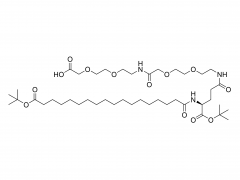
I. Product Overview
Amino-PEG-Acetic Acid (Amine-PEG-Acetic Acid) is a well-defined functional PEG reagent with a variable length of 1–12 ethylene glycol units. The molecule contains a reactive amino group (-NH₂) at one end and a carboxyl group (-COOH) at the other, connected by a polyethylene glycol chain. As an excellent bifunctional linker, it is widely used in bioconjugation, drug delivery, and cutting-edge PROTAC technologies.
II. Structural Features
Amino group (-NH₂): Reacts with carboxylic acids, active esters, aldehydes, etc., to form amide bonds or Schiff bases.
Carboxyl group (-COOH): Can react with amino groups in the presence of activators to form stable amide bonds.
Tunable PEG chain length:
Available with 1–12 ethylene glycol units.
Short chain (PEG1‑4): Low steric hindrance, suitable for tight connections.
Medium/long chain (PEG5‑12): Provides good flexibility and water solubility, enhances biocompatibility.
Excellent physicochemical properties:
Enhanced water solubility and biocompatibility.
Reduced immunogenicity and non‑specific adsorption.
Improved linker stability and in vivo half‑life.
III. Key Application Areas
Bioconjugation Chemistry
Protein/peptide modification: Specific attachment of drugs, fluorescent dyes, or functional groups to biomolecules.
Antibody‑drug conjugates (ADCs): As a linker connecting antibodies and cytotoxic drugs.
Surface functionalization: Modification of nanoparticles, chip surfaces, or biomaterials to introduce reactive functional groups.
Drug Delivery Systems
Prodrug design: Linking active drug molecules with targeting ligands or solubilizing groups.
Nanocarrier modification: Improving water solubility and biocompatibility of carriers.
Controlled release systems: Designing responsive cleavable linkers for condition‑dependent drug release.
Diagnostic Reagent Development
Preparation of fluorescent probes and imaging reagents.
Biosensor interface modification.
Conjugation linkers for in vitro diagnostic reagents.
Materials Science
Functional modification of polymer materials.
Preparation and modification of hydrogels.
Biointerface engineering.
IV. Key Applications in PROTAC Technology
PROTAC (PROteolysis TArgeting Chimera) is a revolutionary targeted protein degradation technology that recruits E3 ubiquitin ligases to induce ubiquitination and subsequent proteasomal degradation of target proteins. PROTAC molecules typically consist of three parts: a target protein ligand, an E3 ligase ligand, and a linker connecting the two.
Advantages in PROTAC Design
Ideal bifunctional linker: The amino and carboxyl ends can be covalently linked to two different ligands.
The flexible PEG chain allows optimization of spatial orientation between the two ligands.
Tunable chain length helps balance cell permeability and degradation efficiency of PROTAC molecules.
Effect of Chain Length on PROTAC Efficacy
Short chain (PEG1‑4):
Improves cell membrane permeability.
Suitable for protein‑ligase pairs requiring a tight connection.
May enhance oral bioavailability.
Medium/long chain (PEG5‑12):
Provides sufficient flexibility to facilitate ternary complex formation.
Reduces steric hindrance, improving degradation efficiency.
Enhances water solubility, facilitating formulation development.