

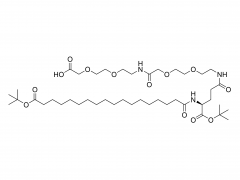
I. Product Overview
CbzNH-PEGn-NH₂ is a multifunctional, dual-group heterobifunctional PEG crosslinker. One end of the molecule features a benzyloxycarbonyl (Cbz) protecting group, while the other end bears a highly reactive primary amine (-NH₂). This unique structural design makes it a critical "bridge" and "linker" in synthetic chemistry, bioconjugation, and drug development, particularly in PROTAC technology.
II. Structural Features
Cbz-Terminus: Benzyloxycarbonyl is an acid-sensitive protecting group. Under mild acidic conditions (e.g., HBr/AcOH, TFA, or catalytic hydrogenolysis), it can be selectively removed to expose a new primary amine (-NH₂), enabling precise "protection-deprotection" control of the amino group.
-NH₂ Terminus: The primary amine is highly nucleophilic and can react with various functional groups, such as:
– Carboxylic acids (-COOH) to form amide bonds (using coupling agents like EDC/NHS)
– Active esters (NHS esters)
– Aldehydes/ketones via reductive amination
Tunable PEG Chain Length:
– Short-chain PEG (n=1-4): Provides minimal steric hindrance and hydrophilicity, suitable for tight connections.
– Long-chain PEG (n=6-12): Significantly enhances water solubility, reduces molecular aggregation, and offers greater spatial span, helping linked moieties maintain independent conformation and function – essential for the efficiency of bifunctional molecules such as PROTACs.
Superior Performance:
– Biocompatibility: PEG chains exhibit good biocompatibility and low immunogenicity.
– Improved pharmacokinetics: Extends blood circulation time and reduces non-specific adsorption.
III. Major Application Areas
Synthetic Chemistry & Materials Science
– Peptide/organic synthesis intermediate: Acts as a protecting group tool for stepwise synthesis of complex molecules.
Bioconjugation & Labeling
– Protein/antibody modification: The NH₂ end conjugates to carboxyl groups or pre-modified active sites on proteins, introducing a Cbz-protected amine for subsequent specific functionalization.
– Fluorescent probe/drug conjugate synthesis: Serves as a linker to connect reporter molecules (e.g., fluorescent dyes) or small-molecule drugs to biomacromolecules.
IV. Application in PROTAC Development
CbzNH-PEGn-NH₂ is a key reagent for designing and synthesizing proteolysis-targeting chimeras (PROTACs), primarily used to construct and optimize the linker.
PEG chain is one of the most common linker components; its flexibility and water solubility facilitate the formation of the correct ternary complex conformation.
By adjusting the n value, researchers can systematically study the impact of linker length on PROTAC degradation activity, selectivity, and cell permeability – making it an important tool for structure-activity relationship (SAR) studies.
Optimizing PROTAC molecular properties:
– Improves solubility: PEG chains effectively address solubility issues associated with many hydrophobic ligands.
– Modulates membrane permeability: Short-chain PEG helps maintain certain cell permeability, while long-chain PEG may be more suitable for designing degraders targeting extracellular or membrane proteins.