News
  • Discussion on Covid-19 Vaccine Excipients
    Discussion on Covid-19 Vaccine Excipients February 26,2021.
    Both frontrunner companies, Moderna and Pfizer-BioNTech, encapsulated their mRNA vaccines using lipid nanoparticles (LNPs) to protect the mRNA from nuclease degradation. LNPs is one of the most advanced delivery systems and has proven to be safe and effective in siRNA delivery. LNP formulations are typically composed of an ionizable lipid, cholesterol, lipid conjugated with polyethylene glycol (PEGylated lipid) and a helper lipid, have recently been recognized as a novel delivery system, and the use of PEG enhances the stability and longevity of the lipid nanoparticles. The mechanism of LNP-mediated delivery of mRNA is not fully understood, but LNPs are suggested to be internalized by endocytosis and are attached electrostatically and fused with the cell membrane via inverted non-bilayer lipid phases. Interestingly, LNPs can also be excreted out of cells by exocytosis,which is a point to note for mRNA delivery via LNPs. Systemically delivered mRNA-LNP complexes mainly target the liver owing to binding of apolipoprotein E and subsequent receptor-mediated uptake by hepatocytes. These microscopic oil-like droplets, approximately 0.1 μm in diameter, surround and protect the fragile mRNA during production, transport, and eventual injection into the body. On the other hand, nanoparticles as vaccine delivery systems can enhance antigen delivery to the target tissue and cell populations of interest, and act as immunostimulatory adjuvants to activate or augment specific immune responses. PEG has never been found in any other vaccine in the world, and this will be another new use of PEG in the pharmaceutical field. SINOPEG is Covid-19 Vaccine Excipients supplier.  research use only
    View More
  • Happy Spring Festival!
    Happy Spring Festival! February 19,2021.
    The Chinese New Year has passed, and SINOPEG hopes to reach cooperation with you in the new year!
    View More
  • SINOPEG COVID-19 Vaccine Excipients Supply
    SINOPEG COVID-19 Vaccine Excipients Supply February 5,2021.
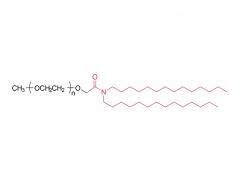
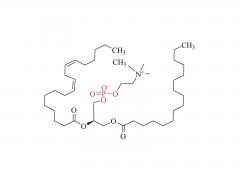
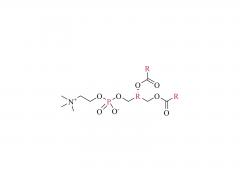
    SINOPEG are Covid-19 Vaccine Excipient Supplier. Lots of the pharmaceutical companies keep developing the Covid-19 vaccine. Now there are two famous USA Vaccines in the market, we can produce and provide main vaccine excipients and have already been one of the main supplier for one of them. Here is our Covid-19 vaccine excipients list. list: ALC-0315 = ((4-hydroxybutyl) azanediyl) bis (hexane-6,1-diyl) bis (2-hexyldecanoate), CAS no. : 2036272-55-4 ALC-0159 = 2-[(polyethylene glycol)-2000]-N,N-ditetradecylacetamide 1,2-distearoyl-sn-glycero-3-phosphocholine, DSPC, CAS no. : 816-94-4 Polyethylene glycol [PEG] 2000 dimyristoyl glycerol [DMG], mPEG2000-DMG, CAS no. : 160743-62-4 SM-102 (heptadecan-9-yl 8-((2-hydroxyethyl)(6-oxO-6-(undecyloxy) hexyl) amino) octanoate) Methoxypoly(ethylene glycol) 2000, mPEG-OH Methoxypoly (ethylene glycol) propylamine 2000, mPEG-CH2CH2CH2-NH2 Methoxypoly(ethylene glycol) carboxymethyl 2000, mPEG-CM research use only
    View More
  • PROTAC LINKER
    PROTAC LINKER January 25,2021.
    PROTAC (proteolysis targeting chimeras) is a kind of dual functional molecules. The PROTAC molecule is composed of three parts: one end is a ligand molecule binding to the target protein to be degraded, the other side is a ligand molecule binding to the E3 ubiquitination ligase, and the middle  is connected by a specific Linker. PROTAC molecules connect the target protein to be degraded with E3 ubiquitination ligases through the above ligands, thus enabling the target protein to be ubiquitinated and further degraded by proteasomes. PROTAC, on the other hand, is not degraded by the proteasome and can be reused. Compared with common small molecule inhibitors, PROTAC molecule catalyzes protein degradation function in a way independent of occupation-driven, showing excellent high selectivity and low toxicity, and can effectively overcome the resistance of traditional small molecule inhibitors. PEG has been widely used as PROTAC Linker! The monodisperse polyethylene glycol derivative produced SINOPEG is the high quality choice of this kind of PROTAC Linker! Welcome to communicate with us!
    View More
  • SINOPEG Gained Substantial Achievement in CPhI China 2020
    SINOPEG Gained Substantial Achievement in CPhI China 2020 December 22,2020.
    CPhI China 2020 was held successfully in Shanghai, China from Dec. 16th-18th.Sinopeg sent a very professional sales team to participate this exhibition. Our booth Number is W4F21. During the exhibition, many customers visited our booth.  Thanks very much for the support and trust from all friends, customers and partners! We hope we can have close cooperation together, and reach win-win achievement in the future.
    View More
  • An injectable self-healing coordinative hydrogel with antibacterial and angiogenic properties for diabetic skin wound repair
    An injectable self-healing coordinative hydrogel with antibacterial and angiogenic properties for diabetic skin wound repair November 17,2020.
    Diabetes can lead to nonhealing chronic ulcers over tendons, bones, and joints, and such conditions have to date led to more than 20 million patients suffering a single leg amputation. It is believed that the number of patients who will require lower limb amputation annually will double by 20301. The primary cause of the dreaded and chronic diabetic ulcer complication is impaired vessel formation, particularly microvasculature formation, which is critical for the delivery of oxygen, nutrients, and growth factors, all of which are needed for wound healing, especially in the early stages. Without sufficient angiogenesis (the formation of capillary blood vessel networks), high levels of glucose accumulate at the wound site, leading to ischemia and tissue necrosis. Thus, the reestablishment of the vascular network of diabetic wounds in the early stages of healing is essential to prevent wound expansion and ulcer formation in diabetic patients. In this article, they report an injectable, self-healing coordinative hydrogel with antibacterial and angiogenic properties for diabetic wound regeneration. The hydrogel (referred to as Ag-SH-PEG) was simply prepared using coordinative crosslinking of multi-arm thiolated polyethylene glycol (SH-PEG) with silver nitrate (AgNO3) (Scheme 1a). Due to the dynamic and reversible nature of the Ag–S coordination bond, the resultant coordinative hydrogel featured self-healing properties after repeated rupture and injectable properties when applied through a medical needle. Such self-healing and injectable properties are particularly appealing for skin wound repair because they help reduce gel fragmentation and integrate ruptured gels at the target site, even after external mechanical destruction, and hence can continuously support skin wound healing. Moreover, the hydrogel network gradually releases antibacterial silver ions, which are highly attractive for use in susceptible open diabetic skin wounds. Due to the incorporation of an angiogenic drug, desferrioxamine (DFO), into the coordinative hydrogel, they finally obtained a multifunctional hydrogel that is manageable, resistant to external stress, antibacterial, and angiogenic (Scheme 1b). As an example, an irregular wound resulting from a foot ulcer is shown; in such cases, it is typically difficult for the vessels to grow in (Scheme 1c), which may be overcome in our proposed formulation. Furthermore, no self-healing hydrogels have been reported to include intrinsic structural properties that promote angiogenesis while simultaneously preventing bacterial infections. They anticipate that such unique multifunctional hydrogels will exhibit efficient anti-infective abilities, enhance angiogenic activity, and subsequently accelerate tissue healing in diabetic skin wound sites (Scheme 1d). Scheme 1 In summary, this article have described a multifunctional hydrogel scaffold with injectable, self-healing, antibacterial, and angiogenic properties for diab...
    View More

  • A “three-in-one” injectable hydrogel platform with osteogenesis, angiogenesis and antibacterial for guiding bone regeneration
    A “three-in-one” injectable hydrogel platform with osteogenesis, angiogenesis and antibacterial for guiding bone regeneration October 20,2020.
    Bone regeneration is a complex process consisting of three major parts, osteogenesis, angiogenesis, and antibacterial. In the past decades, researchers have tried various approaches to guide bone regeneration, for example, some hybrid hydrogels, such as bioactive glass composited gelatin methacryloyl hydrogels, hydroxyapatite incorporated hydrogels, have been reported in guiding bone regeneration . Although enhanced osteogenic differentiation could be observed in these researches, they still fail in coordinating with angiogenesis or antibacterial effects. For now, there are still limited researches on preparing a general platform for properly combining these three parts. In this research they proposed a strategy by using injectable 4-arm-polyethylene glycol-thiol (4-arm-PEG-SH) hydrogel incorporated with liposomes-calcium phosphate nanoparticles (Lip#CaP) to synthesized one general platform in coordinating these three parts including osteogenesis, angiogenesis and antibacterial effect (denoted as ‘three-in-one' hydrogel platform). Compare to other researches, this ‘three-in-one’ hydrogel platform properly guided three process in the bone regeneration process, including the induced angiogenesis caused by the locally released DFO, enhanced osteogenesis caused by CaP-enhanced extracellular matrix mineralization, and broad spectrum antibacterial caused by the combination between Ag+ and bacterial. Additionally, this platform can be totally degraded after 8 week's implant, which avoid occupying the space for the newly generated bone. The antibacterial effect was achieved by Ag+ largely avoiding the antibiotic resistance caused by antibiotics. 1. Chen, H., Cheng, R., Zhao, X., Zhang, Y., Tam, A., & Yan, Y. et al. (2019). An injectable self-healing coordinative hydrogel with antibacterial and angiogenic properties for diabetic skin wound repair. NPG Asia Materials, 11(1). doi: 10.1038/s41427-018-0103-9 If there is any copyright infringement, please contact us and we will remove the content at the first time. Sinopeg provide various NW poly(ethylene glycol) (PEG) products: 2KDa, 5KDa, 10KDa, 20KDa, etc. Products: Linear Monofunctional PEGs Linear Bifunctional PEGs Linear Heterofunctional PEGs Branched PEGs Multi-Arm Functional PEGs Functionally Grafted PEGs
    View More
  • Core-shell structured polyethylene glycol functionalized graphene for energy-storage polymer dielectrics: Combined mechanical and dielectric performances
    Core-shell structured polyethylene glycol functionalized graphene for energy-storage polymer dielectrics: Combined mechanical and dielectric performances September 1,2020.
    Graphene, as the thinnest, strongest and stiffest material and arranged in a honeycomb pattern structure with sp2-hybridized carbon, finds more potential applications in modern industry than other carbonaceous allotropes; in pristine form, it is also an excellent heat and electric conductor . However, the major obstacle in utilizing graphene, particularly for electronic applications, is its insolubility in the fully reduced state due to the strong affinity between the graphene sheets. In the present study, they synthesized for the first time a polydispersed graphene with desirable electric conductivity by covalent functionalization with single terminal aminated polyethylene glycol monomethyl ether (PEG-NH2). The PEG-NH2 grafted graphene (PEG@GO) was then reduced by hydrazine hydrate to PEG@rGO and subsequently incorporated into epoxy resin by a solution mixing method. The PEG@rGO with a“core-shell”structure exhibited homogeneous dispersion in epoxy and also effectively reduced the dielectric loss, hence contributing excellent dielectric properties and mechanical strength to the final PEG@rGO/epoxy nanocomposites. Fig. 1. Low and high magnification SEM images of (a, a’) neat epoxy, (b, b’) PEG@rGO/epoxy 1.0 wt%, and (c, c’) rGO/epoxy 1.0 wt% nanocomposites. Dielectric properties of PEG@rGO/epoxy nanocomposite. Fig. 1 displays representative SEM images of neat epoxy, PEG@rGO/epoxy and rGO/epoxy nanocomposites. The surface of neat epoxy (Fig. 1a and a') displays a typical smooth structure characteristic of its brittleness. The modified PEG@rGO exhibits excellent dispersion in epoxy (black arrows in Fig. 1b) and no obvious aggregates of PEG@rGO are observed. The magnified SEM image of PEG@rGO/epoxy (see Fig. 1b’) reveals some PEG@rGO nanosheets pulled out or dragged from epoxy and also confirms strong interfacial filler/matrix interaction due to the filler surface functionalization. By contrast, untreated graphene (rGO) nanoplatelets aggregate easily in epoxy matrix caused by the inert surface of reduced graphene as demonstrated in Fig.1c and c', yielding poor mixing and dispersion of rGO. Therefore, the excellent dispersion of PEG@rGO compared to untreated rGO results in enhanced dielectric and mechanical properties of the nanocomposites discussed in the next two sub-sections. Fig. 2. Dispersion state of (a) PEG@GO and (b) PEG@rGO in different solvents after different times. It is known that pristine graphene is extremely insoluble in water and other organic solvents, while GO exhibits polydispersed behavior due to the formation of plenty of hydrophilic oxygen groups. The solubility of PEG@GO and PEG@rGO in different solvents are displayed in Fig.2. As expected, PEG@GO shows good compatibility in water, alcohol, acetone and DMF even after 1 week. The good dispersion of PEG@GO is mainly attributed to the oxygen groups at its edges and basal plane. After reduction, PEG@rGO is less soluble than PEG@GO, especially in alcohol and acetone. ...
    View More

first page 21 22 23 24 25 26 27 28 29 30 last page

A total of 32 pages

Copyright © XIAMEN SINOPEG BIOTECH CO., LTD. All Rights Reserved.

Home

Products

News

contact