
Exhibitions & Events
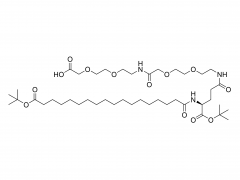
  • Design of Novel Ionizable Lipids Drives Continuous Improvement in mRNA Delivery Efficiency
    Design of Novel Ionizable Lipids Drives Continuous Improvement in mRNA Delivery Efficiency August 21,2026.
    With advantages including flexible design, short development cycles, and strong protein expression capabilities, mRNA technology has been increasingly applied in cutting-edge biomedical fields such as vaccine development, protein replacement therapy, and gene editing. However, due to its limited stability, mRNA is susceptible to degradation by nucleases in the body and cannot directly cross cell membranes. Therefore, achieving safe and efficient intracellular delivery remains a critical challenge limiting the further development and application of mRNA technologies. Lipid nanoparticles (LNPs) are currently one of the most clinically advanced non-viral delivery platforms for mRNA, providing an important technical approach to address mRNA instability and intracellular delivery challenges. In 2018, the FDA approved Onpattro, an LNP-based siRNA therapeutic, marking the clinical advancement of LNP delivery technology. Subsequently, LNP-based mRNA COVID-19 vaccines were approved, further validating the application potential of this delivery platform. With continued advances in research, ionizable lipids, as key functional components of LNPs, have become an important focus for improving mRNA delivery efficiency through structural optimization. Conventional LNPs are mainly composed of ionizable lipids, helper phospholipids, cholesterol, and PEGylated lipids. These components collectively influence the structural stability, in vivo behavior, and delivery performance of LNPs. Among them, ionizable lipids play essential roles in mRNA encapsulation, LNP assembly, and endosomal escape. Their molecular structures also influence cellular uptake and tissue distribution of LNPs. Notably, Onpattro utilizes MC3, Moderna’s mRNA vaccine platform employs SM-102, and the BioNTech/Pfizer mRNA vaccine uses ALC-0315. Despite sharing similar overall LNP compositions, the selection of different ionizable lipids highlights their significant impact on LNP delivery performance. Ionizable Lipids: Key Components Connecting “Encapsulation” and “Intracellular Release” Ionizable lipids typically consist of hydrophilic head groups, linker structures, and hydrophobic tails. Their key feature is the ability to regulate their charge state in response to changes in the surrounding environment. Under acidic conditions during LNP formulation, ionizable lipids become protonated and positively charged, enabling interactions with negatively charged mRNA and promoting nucleic acid encapsulation. Under near-physiological pH conditions (approximately 7.4), ionizable lipids remain largely neutral, which helps reduce nonspecific interactions and improve biocompatibility. After LNPs are taken up by cells and enter acidic endosomes, ionizable lipids undergo protonation again and interact with endosomal membranes, inducing membrane disruption and facilitating mRNA escape into the cytoplasm, thereby initiating protein translation. Therefore, a high-performance ionizable lipid is not simply designed t...
    View More
  • From mRNA to In Vivo CAR-T: Sinopeg's Full Matrix of LNP Excipients
    From mRNA to In Vivo CAR-T: Sinopeg's Full Matrix of LNP Excipients August 17,2026.
    Lipid nanoparticle (LNP) technology has become a key platform in the field of nucleic acid drug delivery. From mRNA vaccines to in vivo CAR-T therapies, the supply of high-quality excipients directly impacts the performance of drug formulations and the progress of clinical translation. Sinopeg has been deeply engaged in the field of LNP delivery system excipients for many years, establishing a comprehensive product matrix covering cationic lipids, PEGylated lipids, helper phospholipids, and cholesterol. We have successfully completed the registration of multiple mainstream LNP lipids in both China and the US (CDE/DMF), hold several proprietary patented structures, and offer customized synthesis services. 01 Proprietary Lipids Among the four major components of LNP delivery systems, ionizable lipids are responsible for nucleic acid drug encapsulation and endosomal escape, serving as the core element determining delivery efficiency. Sinopeg's independently developed DHA-1 series cationic lipids have secured patent portfolios in three major core markets—China, Europe, and the United States—with the US patent granted in Markush generic form. Our patent applications cover a full-chain technical solution from "compound → composition → liposome or lipid nanoparticle → nucleic acid drug composition → formulation and application," establishing a comprehensive LNP delivery system patent framework. If you use our cationic lipid products in your R&D or production, this layered and progressive protection—covering lipid raw materials, lipid compositions, and delivery systems—will provide intellectual property assurance for your project throughout its entire lifecycle, from R&D to commercialization, supporting your progress with greater confidence and stability. Main Products in the DHA-1 Series Cationic Lipids Among them, DHA-1 is one of the earlier ionizable lipid products to complete both CDE pharmaceutical excipient filing and FDA DMF submission. Clients can directly reference the filed dossiers in their drug registration applications in both China and the US (CDE Filing No.: F20230000445; DMF Filing No.: 039452). In terms of PEG lipids, Sinopeg's independently developed mPEG-DTA-1 and HO-PEG-DTA-5 received Chinese patent authorization in 2023 (Patent No.: ZL202280003648.7) and further obtained European patent authorization in 2025 (Patent No.: EP4321504B1). Additionally, mPEG-DTA-1 has also completed CDE filing (Filing No. F20230000444) and DMF submission (Filing No. 039451). 02 DSPE-PEG-X Series The DSPE-PEG-X series is a class of key functionalized lipid materials used for targeted lipid nanoparticles (tLNPs), playing a central role in the technological innovation of transitioning CAR-T therapy from in vitro to in vivo. Sinopeg's pharmaceutical excipient DSPE-PEG-MAL(NH₄⁺)-2K has successfully passed the pharmaceutical excipient registration with the Center for Drug Evaluation (CDE) of the National Medical Products Administration (CDE Filing No.: ...
    View More
  • Can Polysarcosine (pSar) Usher in a New Paradigm for Drug Delivery?
    Can Polysarcosine (pSar) Usher in a New Paradigm for Drug Delivery? August 12,2026.
    In the field of biomedicine, the continuous evolution of drug delivery systems has always been a key driver for advancing therapeutic development. From“naked drugs”to the widespread adoption of PEGylation technology, every breakthrough in material innovation has contributed to improving drug performance and enhancing patient treatment experiences. In recent years, polysarcosine (pSar) has gradually moved from laboratory research toward industrial applications as an emerging biomaterial, providing a new technological pathway for next-generation drug delivery systems. PEG: A Well-Established Platform for Drug Delivery To understand the industrial potential of polysarcosine, it is essential to first recognize polyethylene glycol (PEG), a material platform that has played a significant role in advancing drug delivery technologies. PEG is a water-soluble polymer synthesized through the polymerization of ethylene oxide. Due to its excellent hydrophilicity and biocompatibility, PEGylation has become a well-established modification strategy for proteins, peptides, and nanomedicines. According to Biopharma PEG, more than 40 PEGylated drugs had been approved by the U.S. FDA as of April 2025, demonstrating the mature application status of PEGylation technology in pharmaceutical development. The core value of PEGylation lies in covalently attaching PEG chains to the surface of drugs or nanocarriers to systematically improve drug-like properties. First, PEGylation can significantly extend drug circulation half-life by increasing apparent molecular weight and hydrodynamic volume, reducing rapid renal clearance and supporting long-acting dosing strategies. Second, PEG improves drug stability and solubility. Through steric effects, PEG can reduce enzymatic degradation and protein aggregation, while improving the aqueous solubility of hydrophobic drugs and optimizing the in vivo behavior of molecules such as antibody-drug conjugates (ADCs). Third, PEG enables the construction of long-circulating nanocarriers by forming a hydrated layer on nanoparticle surfaces, reducing protein adsorption and immune recognition, thereby supporting the development of various marketed products, including liposomal anticancer drugs, siRNA therapeutics, and mRNA vaccines. With mature manufacturing processes and well-established clinical value, PEG has profoundly influenced the development of modern pharmaceutical technologies over the past three decades. Polysarcosine: An Endogenous-Inspired Alternative for Drug Delivery Building upon the foundation established by PEG, polysarcosine represents a new material design concept based on its“polypeptide-like”and“endogenous-inspired”molecular characteristics. Chemically, polysarcosine is poly(N-methyl glycine), belonging to the polypeptoid family. Its monomer, sarcosine, is a naturally occurring metabolite in the human body. Unlike PEG, which contains an ether-linked backbone, polysarcosine consists of an amide-linked backbone, combining th...
    View More
  • Happy Dragon Boat Festival from all of us at Sinopeg!
  • SINOEPG's invitation | CPHI China 2026
    SINOEPG's invitation | CPHI China 2026 June 8,2026.
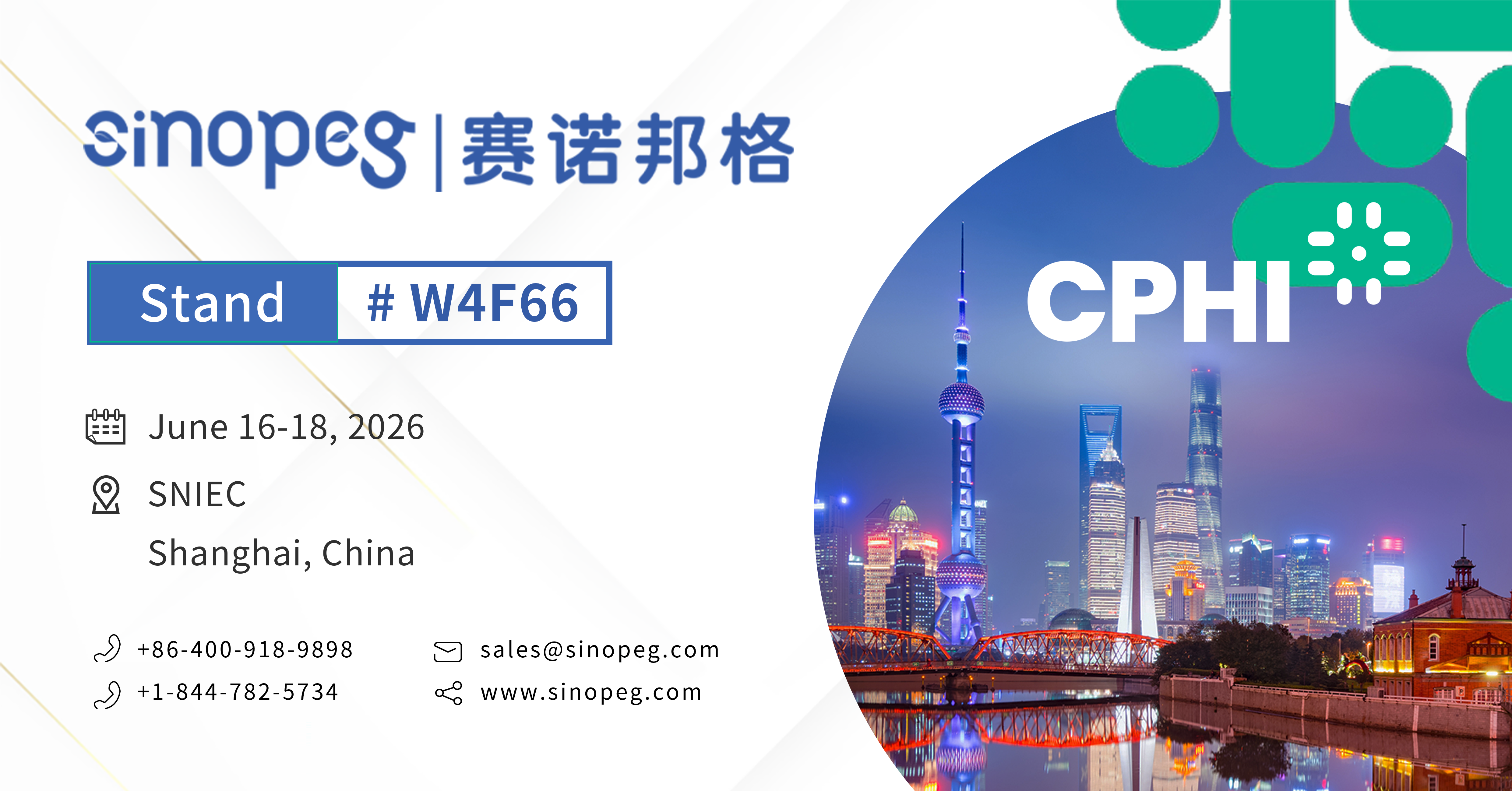
    Join Us at CPHI China 2026! SINOPEG's booth no. W4F66 Exciting news! CPHI China 2026 is just around the corner, taking place June 16–18 at the Shanghai New International Expo Centre. SINOPEG will be showcasing cutting-edge drug delivery system (DDS) solutions at Booth W4F66. As your trusted partner in specialty chemicals and advanced drug delivery systems, we’re eager to share innovations that drive industry progress. Why visit us? Explore our latest portfolio of PEG derivatives, lipids, and custom synthesis services Discuss tailored solutions for your R&D and manufacturing challenges Connect face-to-face with our technical experts We warmly welcome friends, partners, and industry peers from around the globe to drop by! Let’s collaborate to shape the future of pharma. Dates: June 16–18, 2026 Venue: Shanghai New International Expo Centre Our Booth: W4F66 (Hall W4) Ready to meet? Simply stop by!
    View More
  • Happy International Workers' Day!
  • Join Us at TIDES USA 2026 in Hynes Convention Center! Booth #1010
    Join Us at TIDES USA 2026 in Hynes Convention Center! Booth #1010 April 28,2026.
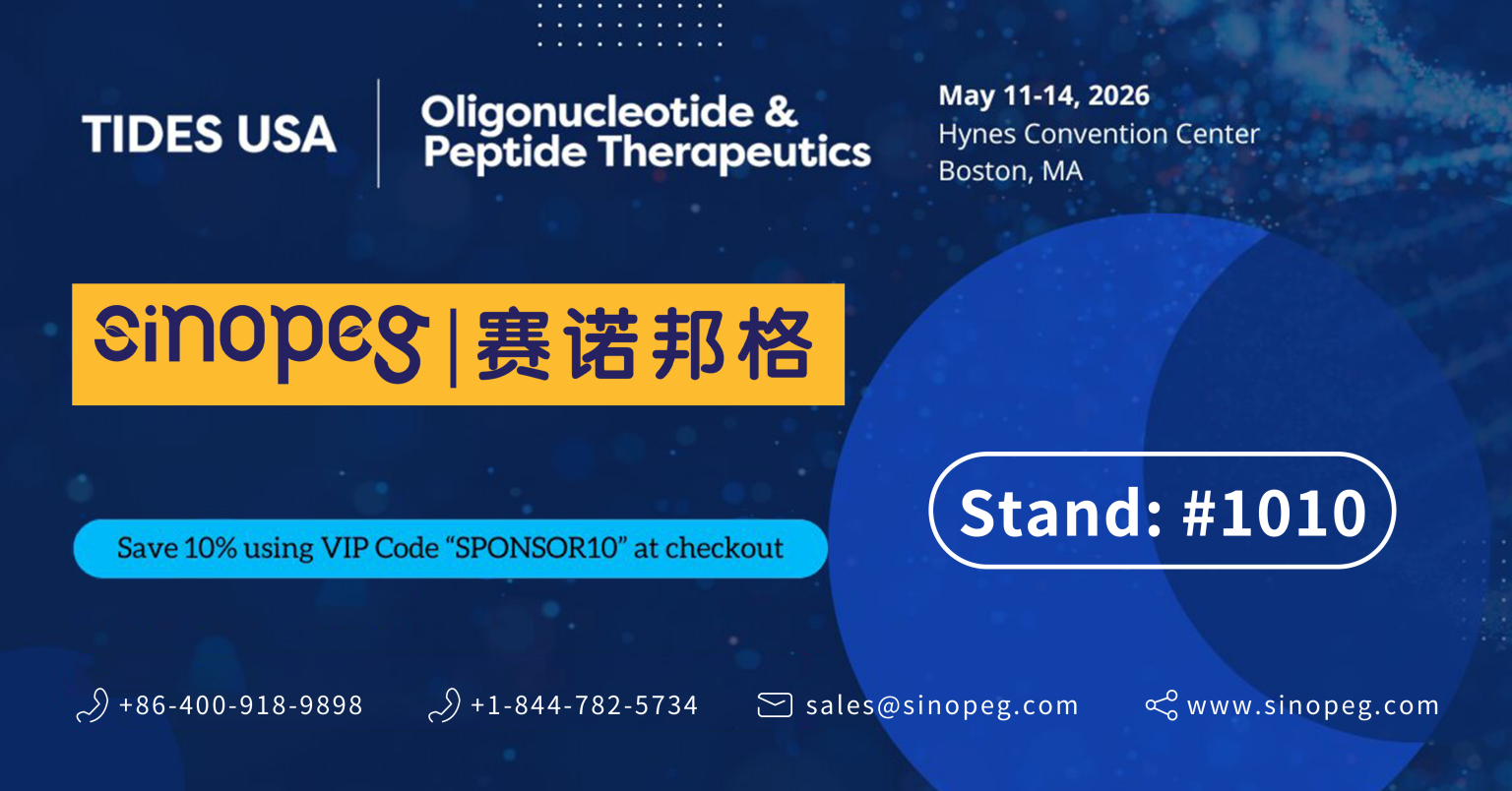
    Join Us at TIDES USA 2026 in Hynes Convention Center! Mark your calendars! TIDES USA 2026—the premier event for oligonucleotide and peptide therapeutics—is coming to Boston, MA, on May 11-14, 2026. Visit Sinopeg at Booth #1010 to explore cutting-edge solutions in: Custom PEG Derivatives (mPEG, heterobifunctional PEGs, branched PEGs) Lipid Nanoparticles (LNPs) & Lipidoids for nucleic acid delivery Innovative Linker Technologies & ADC Payloads Why Stop By? Discuss your formulation challenges with our PEGylation experts Discover high-purity excipients for mRNA, siRNA, and peptide therapies Learn how our GMP-grade materials accelerate preclinical-to-commercial transitions Spotlight Case Study: Ask us about our role in developing temperature-stable LNP formulations for a global mRNA vaccine partner! Schedule a 1:1 Meeting: Avoid the crowds—reserve your private session today: sales@sinopeg.com Can't attend? Explore our solutions online: http://www.sinopeg.com Let's shape the future of oligonucleotide and peptide therapeutics together! See you at #1010. #TIDES2026 DrugDiscovery #LNPs #mRNA #PeptideTherapeutics #BiotechInnovation
    View More
  • Tri-Regional Authorization! Sinopeg’s DHA-1 Series Cationic Lipids Receive U.S. Patent Allowance with Markush Formula
    Tri-Regional Authorization! Sinopeg’s DHA-1 Series Cationic Lipids Receive U.S. Patent Allowance with Markush Formula April 14,2026.
    Spring brings another good news! Following the European patent allowance for cationic lipids in February 2026, our patent portfolio has achieved another milestone. In April 2026, several cationic lipid products independently developed by Sinopeg—including DHA-1, SNP24-1, SNP25-1, and SNP26-1—successfully received U.S. patent allowance, protected in the form of a Markush formula. With this, the DHA-1 series cationic lipids have now secured patent coverage in the three core markets of China, Europe, and the United States, establishing a global intellectual property moat for this key excipient of LNP delivery systems. Patent Title: Cationic Lipid, Liposome Containing Cationic Lipid, and Nucleic-Acid Pharmaceutical Composition Containing Liposome and Formulation and Application Thereof Patent Application No.: 18/269,728 Applicant: Xiamen Sinopeg Biotech Co., Ltd. Source: Notice of Allowance from the USPTO (screenshot) Patent Breakthrough: Comprehensive Coverage from China to Europe and the U.S. DHA-1, SNP24-1, SNP25-1, SNP26-1, and others are cationic lipids independently developed by Sinopeg. They feature high biocompatibility and high transfection efficiency, effectively bypassing existing patent restrictions and providing a reliable, localized alternative for the LNP delivery field. In terms of IP strategy, the patent journey for the DHA-1 series has been solid and methodical: September 2022: Granted Chinese patent (priority application). October 2023: Granted patent for PCT national phase entry in China. February 2026: Granted European patent, achieving full coverage in China and Europe. April 2026: Granted U.S. patent, protected in Markush formula form. Thus, the DHA-1 series cationic lipids now hold patent protection in all three major markets—China, Europe, and the U.S.—providing a strong legal foundation for compliant commercialization and global business expansion. Beyond patent coverage, DHA-1 also leads in regulatory compliance: it has successfully completed CDE pharmaceutical excipient filing in China (Filing No. F20230000445) and has submitted a U.S. FDA DMF (Filing No. 039452). Customers can directly reference Sinopeg's filed dossiers in both China and the U.S., significantly reducing submission preparation time and accelerating project progress. Markush Formula Allowance: Broader Protection, Stronger Barrier What is a Markush formula allowance, and how is it different from a standard compound patent? Simply put, the Markush formula is one of the most valuable forms of patent protection in the pharmaceutical compound field. It uses a "generic formula" approach, covering a class of compounds that share a common structure and similar properties, rather than protecting only a single structure. For this series of cationic lipids, this means: Broader protection – The patent covers not only the dozens of specific structures exemplified (including DHA-1, SNP24-1, SNP25-1, SNP26-1) but also other cationic lipid structures sharing the same core ...
    View More
first page 1 2 3 4 5 6 7 8 last page

A total of 8 pages

Copyright © XIAMEN SINOPEG BIOTECH CO., LTD. All Rights Reserved.

Home

Products

News

contact